The GAME Act: Proposed BLM Land Exchange
Expanded Public Access. High-Value Wildlife Habitat. Protected Open Space. Better-Connected Public Lands.
OUT OF BOUNDS RANCH | PUBLICATION | SEPTEMBER 2, 2026
A Land Exchange Designed to Deliver Lasting Public Benefits
The GAME Act is a proposed federal land exchange built around a simple idea: put high-value private lands where they can provide greater public benefit into public ownership, while consolidating fragmented federal lands into a more manageable rural working landscape.
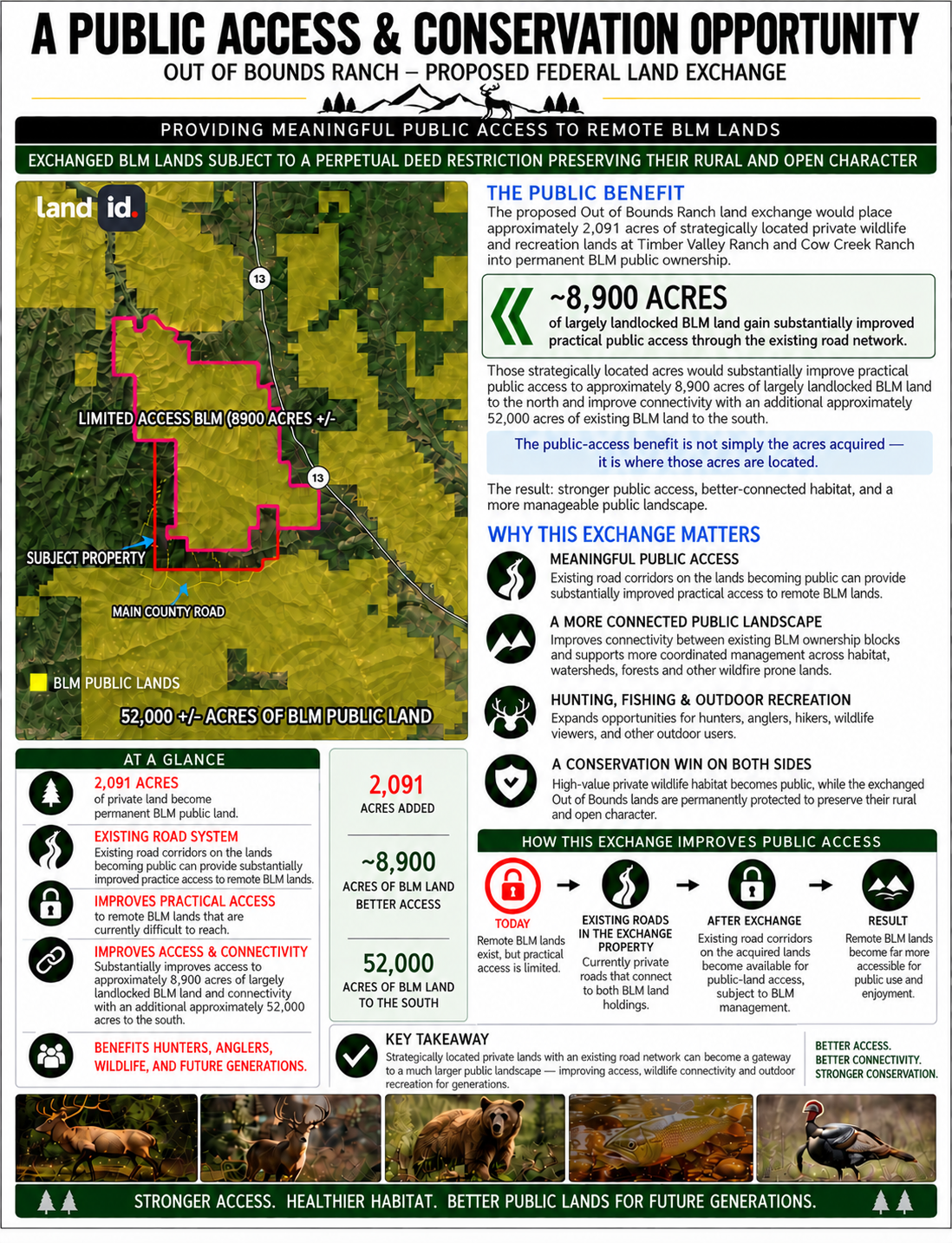
Under the proposal, approximately 2,091 acres of private land at Cow Creek Ranch and Timber Valley Ranch would become federal public land managed by the Bureau of Land Management.
In exchange, approximately 2,179 acres of BLM-administered land would become private. Of those lands, approximately 2,139 acres located within and adjacent to Out of Bounds Ranch would become part of the ranch and be subject to a perpetual deed restriction protecting their rural and open character from residential subdivision and development. The remaining approximately 40 acres are an isolated BLM parcel in Eagle County surrounded by private land.
The result would provide a conservation benefit on both sides of the exchange: high-value wildlife habitat would become public land at Cow Creek and Timber Valley, while the lands incorporated into Out of Bounds Ranch would remain part of an open, rural working landscape permanently protected against residential fragmentation and development.
2,091 ACRES WOULD BECOME FEDERAL PUBLIC LAND
ACCESS TO APPROXIMATELY 8,900 ACRES OF EXISTING BLM PUBLIC LAND
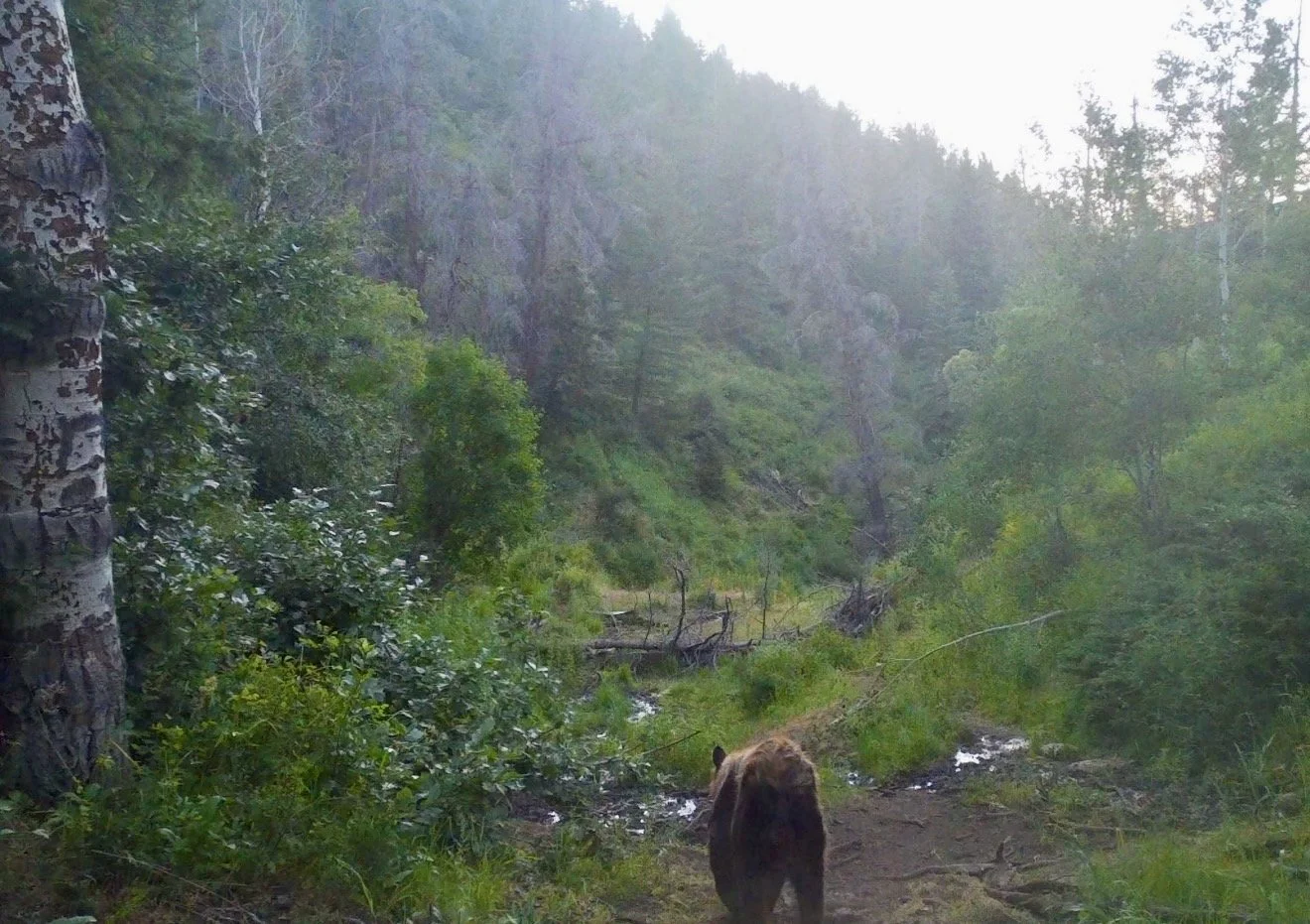
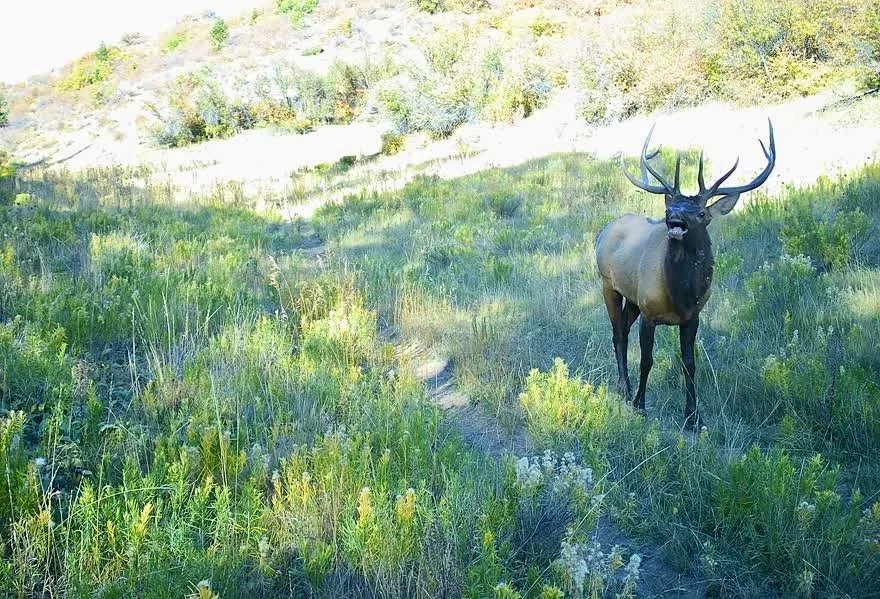
HIGH-VALUE BIG-GAME HABITAT FOR ELK, DEER, TURKEY AND OTHER WILDLIFE
What the Public Would Receive
Cow Creek Ranch and Timber Valley Ranch would become federal public lands. Their location within the surrounding BLM landscape is a major part of the public benefit, helping to substantially improve practical public access to approximately 8,900 acres of existing northern BLM land and improve connectivity with an additional approximately 52,000 acres of existing BLM land to the south.
The location of Cow Creek and Timber Valley is an important part of the proposal. As the map illustrates, the private lands proposed for transfer to BLM are positioned among existing federal public lands. Bringing them into federal ownership would help to connect and consolidate those BLM holdings and improve practical access to portions of existing public land where surrounding private ownership currently constrains access.
Garfield County's July 23, 2026 public materials report that Colorado Parks and Wildlife identified the Cow Creek and Timber Valley properties as containing some of the highest-value big-game hunting habitat in the state, supporting elk, deer, turkey and other wildlife. This statement should not be confused with a formal CPW endorsement of the GAME Act; it is the wildlife assessment reported by Garfield County in support of its resolution.
Garfield County also states that the exchange would provide public access to approximately 8,900 acres of existing BLM land northwest of Rifle. The County identifies hunting and other recreation opportunities associated with the lands, including hiking, fishing, mountain biking, ATV and off-road use, snowmobiling and other activities where allowed under federal management.
If the exchange is completed, the approximately 2,091 acres conveyed to the United States would be managed under the laws, rules and regulations applicable to BLM public lands.
What Out of Bounds Ranch Would Receive
Approximately 2,139 acres of BLM-administered land within and adjacent to Out of Bounds Ranch would become private land incorporated into the ranch.
These lands are already closely integrated with the surrounding working-ranch landscape. They are part of a remote, rural Western Colorado landscape characterized by ranching, grazing, wildlife habitat, open space, rugged terrain and large blocks of federal and private land.
Consolidating this fragmented ownership pattern would allow grazing, fencing, water systems, weed control, forest health, wildlife-habitat work and wildfire mitigation to be planned and managed across a more coherent landscape.
The ranch's working relationship with the surrounding federal range also predates this proposal. Recorded Garfield County documents show predecessor ranch property associated with federal grazing rights and privileges by at least 1966. Later federal records identify the Gould Allotment, and current ranch records continue to associate that allotment with OBR. OBR does not claim that this proves continuous use of the exact exchange parcels before 1966.
BLM’s Own Access Record: “Significantly Restricted” “Insufficient to support BLM planned recreational purposes”
Public ownership and practical public access are not always the same thing.
That distinction is particularly relevant to the BLM lands near Out of Bounds Ranch proposed for exchange under the GAME Act.
Long before the current debate over this proposal, the Bureau of Land Management evaluated public-access conditions in this area as part of its implementation of the John D. Dingell, Jr. Conservation, Management, and Recreation Act.
In BLM’s 2020 Dingell Act Priority Access List, the agency specifically identified the Consolidated Reservoir area within the Colorado River Valley Field Office. BLM classified: 0 acres as legally inaccessible, 2,017 acres as significantly restricted. The 2,017-acre Consolidated Reservoir area represents the vast majority of the BLM land near Out of Bounds Ranch proposed for exchange.
BLM’s own implementation guidance defines “Significantly Restricted Legal Public Access” as a situation where “legal public access exists to area but is insufficient to support BLM planned recreational purposes.”
BLM further explains that significantly restricted access can include circumstances where legal access reaches only one portion of a large public-land area, where terrain creates substantial physical barriers for recreationists, or where the limited roads serving public lands cross private property without permanent legal public access.
What the federal record does establish is straightforward:
BLM formally classified 2,017 acres in the Consolidated Reservoir area as having “significantly restricted” public access in 2020, 2022, and 2024.
That determination was not temporary. This federal record provides important context for understanding the existing BLM lands involved in the proposed exchange. The lands are public, and they have public value. But the existence of public ownership should not be confused with unrestricted or readily usable public access.
BLM’s own records recognize that distinction.
Permanently Protected Open Space and Increased Conservation
Becoming private land would not mean becoming unrestricted or opening the lands to residential development.
Out of Bounds Ranch has committed to a perpetual deed restriction designed to preserve the lands’ existing rural and open character and prevent residential fragmentation and development that could fundamentally change this landscape.
The restriction would preserve the lands as part of an open working landscape while allowing ranching and agriculture, wildlife and conservation work, forest management, wildfire mitigation, water-related operations and improvements reasonably necessary to operate and care for the ranch.
That creates an important conservation benefit: approximately 2,139 acres would be consolidated into a more coherent working landscape while being permanently protected against residential subdivision and development.
The objective is straightforward: preserve open space, prevent residential fragmentation and development, keep the landscape rural, and ensure it remains actively managed for generations.
What About the Connection to White River National Forest?
At its northern end, the BLM acreage proposed for exchange physically connects to White River National Forest. That public-land ownership connection is real and should be described accurately.
However, it is not an established public-access route to the National Forest. There is no public trailhead on the BLM exchange property, no established public trail connecting through the property to White River National Forest, and no public motorized access along the existing ranch/BLM road.
Reaching the National Forest through this particular connection requires a long, rough overland trip on foot or horseback. Separate public access to White River National Forest remains available nearby from the Red Canyon Road area.
The exchange would end this particular continuous public-land ownership connection, but it would not eliminate public access to White River National Forest. At the same time, the GAME Act would place approximately 2,091 acres of strategically located private land into public ownership, substantially improving practical access to approximately 8,900 acres of largely landlocked BLM land and improving connectivity with an additional approximately 52,000 acres of existing BLM land to the south.
Water, Consolidated Reservoir and the Exchange
Consolidated Reservoir is located on BLM-administered surface land, but the reservoir facility and its private water interests predate the GAME Act.
Out of Bounds Ranch and a neighboring landowner already hold six of the reservoir’s ten shares. When water is available, it is used for agricultural purposes, including crops and ranch operations. The reservoir is currently empty.
The proposed exchange does not create or transfer any new water rights to Out of Bounds Ranch. Existing water rights and ownership interests would remain unchanged, and the other owners would retain their separate reservoir and water interests.
Oil, Gas and Mineral Interests
There are no mineral interests associated with Cow Creek Ranch or Timber Valley Ranch being conveyed to the United States. Because the federal government would not receive mineral interests with those private lands, proponents expect BLM to retain the federally owned mineral interests associated with the federal lands being exchanged.
Ultimately, the treatment of federally owned mineral interests is subject to BLM’s determination as part of the exchange process.The GAME Act does not require federal mineral interests to be conveyed to Out of Bounds Ranch.
Protecting Taxpayers: Independent Appraisal and Equal Value
A federal land exchange should not depend on guesswork about value. The GAME Act requires an independent federal appraisal process.
The lands and property interests involved would be appraised by qualified independent appraisers under applicable federal appraisal standards.
If the federal lands are worth more than the private lands, Out of Bounds Ranch must make a cash equalization payment to the United States. If the private lands are worth more, the current draft does not require the United States to pay Out of Bounds Ranch the difference.
Out of Bounds Ranch would also pay the administrative costs associated with the exchange.
Independent appraisal. Equal value. Taxpayer protection.
No final federal appraisal has yet determined the values of the properties. That is exactly why an independent appraisal is required.
Garfield County’s Adopted Policies Support the Game Act
Garfield County did more than simply vote to support the GAME Act.
The Board specifically found that the proposal is consistent with the County’s adopted Federal Lands Natural Resources Coordination Plan and Policies.
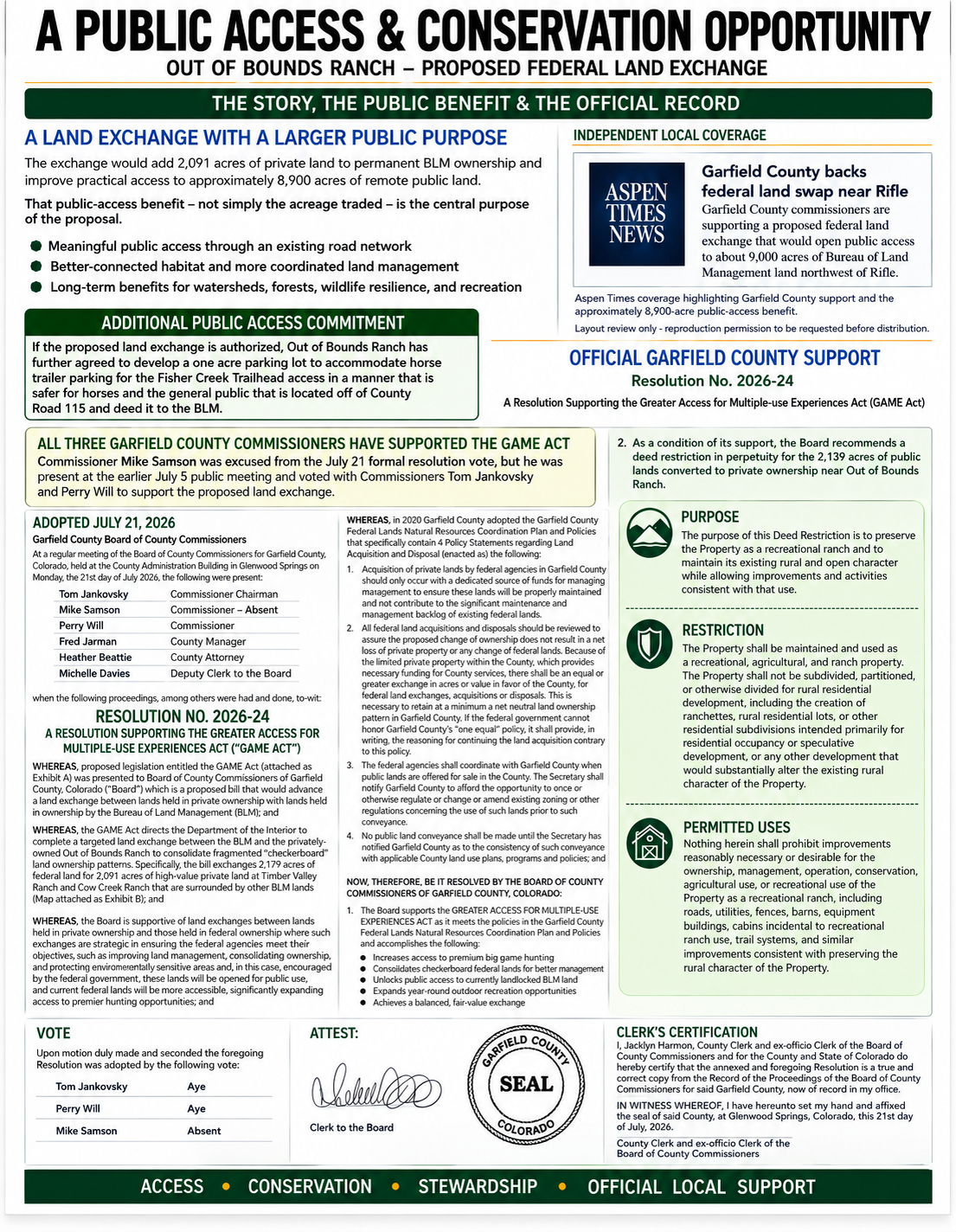
In its resolution, the County identified five principal benefits:
Increased access to premium big-game hunting
Consolidation of checkerboard federal lands for better management
Public access to currently landlocked BLM land
Expanded year-round outdoor recreation opportunities
A balanced, fair-value exchange
All Three Garfield County Commissioners Supported the GAME Act
At the initial public consideration on July 5, 2026, Commissioners Tom Jankovsky, Perry Will and Mike Samson were all present and voted to support the exchange.
The Board later formally approved its resolution of support 2-0 on July 21, 2026, with Commissioner Samson excused from that meeting.
Commissioner Perry Will summarized the broader conclusion:
“The greater public good for the citizens of Garfield County is for this exchange.”
Why Congress?
Some critics have suggested that seeking congressional authorization for the GAME Act is unusual or somehow a way around the normal land-exchange process.
BLM still has authority under the Federal Land Policy and Management Act to complete certain land exchanges administratively. But federal land exchanges can be complicated transactions requiring significant agency staff time, environmental review, surveys, title work, appraisals, mineral evaluations and coordination among multiple parties.
Proponents initially explored pursuing this exchange administratively through BLM. According to testimony before Garfield County, the practical response was that BLM did not have the personnel and resources necessary to take on an exchange of this complexity through the ordinary administrative process.
The decision to seek congressional authorization was therefore not an effort to avoid review. It was a way to provide clear direction and a pathway for the exchange to actually be considered and reach a decision.
Congressional Authorization Does Not Eliminate Public Review
Congressional authorization does not mean environmental review or public participation disappears.
The current draft does not waive NEPA or prohibit public comment. The responsible federal agencies would still conduct applicable environmental review, and the public would continue to have opportunities to participate and comment.
The exchange would also remain subject to independent appraisal and the other requirements established in the legislation.
Congressional direction can provide certainty and a path toward a decision without eliminating environmental review, public participation, taxpayer protections or local-government involvement.
The Bottom Line
Put approximately 2,091 acres of high-value private land at Cow Creek and Timber Valley into federal public ownership
Improve access and connectivity across tens of thousands of acres of existing BLM land
Help unlock practical access to a largely landlocked approximately 8,900-acre northern BLM block
Add exceptional elk, deer, bear, turkey and other wildlife habitat to the public estate
Expand hunting, fishing and year-round outdoor recreation
Improve public access near Fischer Creek through a proposed parking area capable of accommodating horse trailers and moving recreation traffic off County Road 115
Permanently protect the rural and open character of the approximately 2,139 deed-restricted acres incorporated into Out of Bounds Ranch
Require independent appraisal, value equalization and private payment of administrative costs
Leave NEPA in place and allow continued public participation and comments
More Public Access.
More Opportunities to Hunt, Fish and Get Outdoors.
Better-Connected Public Lands.
Permanently Protected Open Space and Increased Conservation.
A Fair Exchange.
MYTH VS. FACT
MYTH: “The GAME Act is simply giving away more than 2,000 acres of public land.”
FACT: This is a land exchange, not a giveaway.
The GAME Act would exchange approximately 2,179 acres of federal land for approximately 2,091 acres of high-value private land at Cow Creek Ranch and Timber Valley Ranch. Cow Creek and Timber Valley contain existing road corridors that can substantially improve entry into this northern 8,900 acre BLM federal block from the main county road within the southern 52,000 acre BLM block.
Of the federal lands becoming private, approximately 2,139 acres near Out of Bounds Ranch would be subject to a perpetual deed restriction protecting their rural and open character. The remaining approximately 40 acres are a separate, isolated BLM parcel in Eagle County surrounded by private land.
A difference in acreage does not determine value. The legislation requires independent federal appraisal and value equalization.
And the public benefit extends far beyond the 2,091 acres acquired. Their strategic location would improve access and connectivity across tens of thousands of acres of existing BLM land.
MYTH: “Cow Creek and Timber Valley are just steep, dry brush country with little public value.”
FACT: Rugged terrain is not worthless terrain. In Western Colorado, it is often some of the most valuable wildlife habitat and hunting country.
Cow Creek and Timber Valley provide premier big-game habitat for elk, deer, turkey, bear and other wildlife. Colorado Parks and Wildlife identified the properties as its top recommendation among the lands evaluated for acquisition, with some of the highest-value big-game hunting habitat in the state.
Garfield County Commissioner Perry Will, a former Colorado Parks and Wildlife area wildlife manager, was particularly clear about the value of Cow Creek, describing the opportunity to bring it into public ownership as a“once in a lifetime thing for Garfield County.” He also concluded that “the greater public good for the citizens of Garfield County is for this exchange.”
These are also not properties being treated as worthless on the private market. More than $7 million in private capital is being committed to acquire Cow Creek and Timber Valley for the purpose of ultimately conveying the properties to the United States and placing them into the public estate.
And their public value extends far beyond the 2,091 acres themselves. Their strategic location would substantially improve practical public access to approximately 8,900 acres of largely landlocked existing BLM land and improve connectivity with an additional approximately 52,000 acres of BLM land to the south.
The public is not receiving “worthless brush.” It would receive 2,091 acres of premier wildlife habitat, new hunting and recreation opportunities, and strategically located lands that improve access and connectivity across tens of thousands of acres of existing public land.
MYTH: “The 8,900 acres aren’t really being opened to the public because the BLM land already has some access.”
FACT: The approximately 8,900-acre northern BLM block is already public, but it is effectively landlocked from practical public access by the surrounding pattern of private ownership.
The existence of some theoretical or limited access is not the same as meaningful and practical public access.
Cow Creek and Timber Valley contain existing road corridors that can substantially improve entry into this federal block.
The issue is the degree and quality of public access, not whether someone can theoretically reach the acreage by some route.
MYTH: “Out of Bounds Ranch is being handed more than 2,000 acres of unrestricted federal land it has no existing connection to.”
FACT: The approximately 2,139 deed-restricted acres near Out of Bounds Ranch are already closely integrated with the surrounding working-ranch landscape.
According to testimony before Garfield County, Out of Bounds Ranch and its neighboring ranch to the north are the only parties currently utilizing these BLM lands for livestock grazing. Out of Bounds Ranch also already has land and road access through portions of the federal acreage.
This is a remote, rural Western Colorado landscape characterized by ranching, grazing, wildlife habitat, open space and rugged terrain.
The lands would not become unrestricted. Out of Bounds Ranch has committed to a perpetual deed restriction protecting their rural and open character and prohibiting subdivision, rural residential lots, residential subdivisions, speculative development and other development that would substantially alter the lands’ rural character.
The exchange would consolidate and permanently protect a rural working landscape, not open it to residential or other development.
MYTH: “The exchange destroys public access to White River National Forest where people hike to watch the sunset over Glenwood Canyon.”
FACT: The public-land ownership connection is real, but it is not an established public-access route to White River National Forest.
There is no public trailhead on the approximately 2,139 acres proposed for exchange, no established public trail across the property connecting to White River National Forest, and no public motorized access along the existing ranch/BLM road.
Reaching the National Forest through this particular connection requires a long, rough overland trip on foot or horseback. Separate public access to White River National Forest remains available nearby from the Red Canyon Road area.
The exchange would end this particular continuous public-land ownership connection, but it would not eliminate public access to White River National Forest.
At the same time, approximately 2,091 acres of strategically located private land would become public, substantially improving practical access to approximately 8,900 acres of largely landlocked BLM land and improving connectivity with an additional approximately 52,000 acres of existing BLM land to the south.
The GAME Act exchanges a difficult, undeveloped public-land connection for substantially improved practical access to tens of thousands of acres of existing public land.
MYTH: “Out of Bounds Ranch is being given a valuable BLM reservoir and water rights.”
FACT: This claim confuses BLM ownership of the surface land with ownership of the reservoir facility and the private water rights associated with it.
Consolidated Reservoir is located on BLM-administered surface land, but the reservoir facility and its water interests are privately owned and predate the GAME Act.
Out of Bounds Ranch and a neighboring landowner already own six of the reservoir’s ten shares. The reservoir water, when available, is used for agricultural purposes, including crops and ranch operations.
The reservoir is currently empty.
Most importantly, the legislation does not change the existing water rights in any way. Other reservoir and water-right owners retain their existing interests, and the GAME Act does not transfer those interests to Out of Bounds Ranch or create any new water right for the ranch.
The reservoir, its ownership interests and the agricultural water rights already exist today. The GAME Act does not alter them.
MYTH: “The federal government is giving Out of Bounds Ranch valuable mineral rights.”
FACT: The GAME Act does not require federal mineral interests to be conveyed to Out of Bounds Ranch.
There are no mineral interests associated with Cow Creek Ranch or Timber Valley Ranch being conveyed to the United States. Because the federal government would not receive mineral interests with those private lands, proponents expect BLM to retain the federally owned mineral interests associated with the federal lands being exchanged.
Ultimately, however, the treatment of federally owned mineral interests is subject to BLM’s determination as part of the exchange process.
The GAME Act does not require the federal mineral interests to be conveyed, and BLM retains authority to determine whether those interests are conveyed or retained by the United States.
MYTH: “There is no appraisal and taxpayers could get stuck with an unfair deal.”
FACT: The GAME Act requires independent federal appraisal and value equalization.
No federal appraisal has yet determined the value of the properties because the appraisal occurs at a later stage in the federal land-exchange process. That is precisely why the legislation requires an independent appraisal before the exchange can be completed.
If the appraisal determines that the federal lands are worth more than the private lands, Out of Bounds Ranch must make a cash equalization payment to the United States to make up the difference.
Out of Bounds Ranch would also be responsible for the administrative costs associated with completing the exchange.
The exchange cannot simply move forward at an assumed value. The properties must be independently appraised and the values equalized before the exchange is completed.
Independent appraisal. Equal value. Taxpayer protection.
MYTH: “Out of Bounds Ranch does not even own all of the replacement properties, so the exchange is illegitimate.”
FACT: Out of Bounds Ranch has legally binding contracts to acquire both Cow Creek Ranch and Timber Valley Ranch for the purpose of completing the proposed land exchange.
As explained during the Garfield County hearing, the two properties are currently held by separate ownership entities, and Out of Bounds Ranch has entered into contracts with those owners to acquire the properties if the GAME Act moves forward.
Out of Bounds Ranch has also already made earnest-money payments toward those purchases. If the exchange does not move forward, Out of Bounds Ranch risks forfeiting that earnest money. If it does move forward, Out of Bounds Ranch must complete the purchases and pay the agreed-upon market price for the properties.
There is nothing unusual or improper about securing private property under contract for the purpose of completing a federal land exchange. What ultimately matters is whether the properties can be conveyed to the United States and whether the exchange satisfies the required federal appraisal and value-equalization requirements.
In fact, the arrangement means private capital is being committed to acquire 2,091 acres of premier wildlife habitat for the purpose of ultimately placing that land into public ownership.
Out of Bounds Ranch does not need to own the replacement lands years in advance. It needs the legal ability to acquire and convey them when the exchange is completed — and binding contracts are already in place to do exactly that.
MYTH: “Local concerns have been ignored.”
FACT: Local input was sought before the GAME Act was introduced in Congress, and that feedback has already changed and improved the proposal.
The proposal was presented to local officials and members of the community while the legislation was still being developed, giving people an opportunity to raise concerns and recommend changes before a bill was introduced.
That local engagement resulted in meaningful changes and additional commitments, including:
Revised maps and acreage information to provide greater clarity about the lands involved in the exchange
A commitment to a perpetual deed restriction protecting the rural and open character of the lands incorporated into Out of Bounds Ranch
Discussions and an offer addressing High Aspen Ranch and Homestead Estates road and access concerns
A public commitment to develop an approximately one-acre parking area serving Fischer Creek, with space for horse trailers, located off County Road 115, and convey it to BLM to provide safer, more functional public access
The GAME Act has not been developed in isolation. The proposal has evolved in direct response to local input.
MYTH: “Going through Congress is a way to bypass BLM, NEPA and public review.”
FACT: Congressional direction is a well-established pathway for significant federal land exchanges, and pursuing the GAME Act through Congress does not mean bypassing BLM, NEPA or public review.
Proponents first explored completing the exchange administratively through BLM. According to testimony before Garfield County, BLM officials indicated that the agency did not have the personnel or resources necessary to undertake an exchange of this complexity through the ordinary administrative process.
That is why congressional authorization is being pursued: to provide clear direction and a pathway for the exchange to actually be considered and reach a decision, not to eliminate the federal review process.
The current GAME Act draft:
Does not waive NEPA
Does not remove BLM from the process
Requires independent federal appraisal and value equalization
Leaves important implementation decisions with BLM
Allows continued public and local-government participation
And far from trying to avoid public scrutiny, proponents sought local input before the legislation was introduced. The proposal was presented to Garfield County and discussed with members of the community while it was still being developed, and that feedback has already resulted in revisions and additional commitments.
Congressional authorization does not mean Congress simply hands over federal land. It provides the legal direction for BLM to evaluate and carry out a specific exchange subject to the requirements established by Congress and applicable federal review.
The goal is not to bypass review. It is to prevent a potentially beneficial land exchange from languishing indefinitely because the administrative process lacks the resources to move it forward.
Public Reference Documents - For readers who want to review the public record directly:
Garfield County Board of County Commissioners Meeting - July 6, 2026
Garfield County Board of County Commissioners Meeting - July 21, 2026
Garfield County, July 23, 2026: “BOCC supports proposed federal land swap.” https://www.garfieldcountyco.gov/news/bocc-supports-proposed-federal-land-swap/
Bureau of Land Management dam inventory: Consolidated Reservoir, NID CO00677, owner listed as Consolidated Reservoir Company; State of Colorado listed as inspecting agency. https://www.blm.gov/sites/blm.gov/files/uploads/IM2013-124_att1.pdf
Colorado Legislative Council, State Water Policy: A Legislator's Guide to Colorado Water Issues - explains that a Colorado water right is a property interest separate from the land. https://content.leg.colorado.gov/sites/default/files/2017state_water_policy_handbook_update_to_print.pdf
Colorado Legislative Council, State Water Policy: A Legislator's Guide to Colorado Water Issues - explains that a Colorado water right is a property interest separate from the land. https://content.leg.colorado.gov/sites/default/files/2017state_water_policy_handbook_update_to_print.pdf
PostIndependent News Article - Garfield County backs federal land swap near Rifle
Bureau of Land Management - 2020 Dingell Act Priority Access List
BLM’s parcel-level record identifying Consolidated Reservoir as 2,017 acres of significantly restricted public land.
Open source
Bureau of Land Management - Dingell Act Implementation Guidance
BLM’s explanation of what “Significantly Restricted Legal Public Access” means and examples of the access conditions that can fall within that classification.
Open source
Bureau of Land Management - 2024 Dingell Act Priority Access List
BLM’s current published list continuing to identify Consolidated Reservoir as 2,017 significantly restricted acres.
Open source

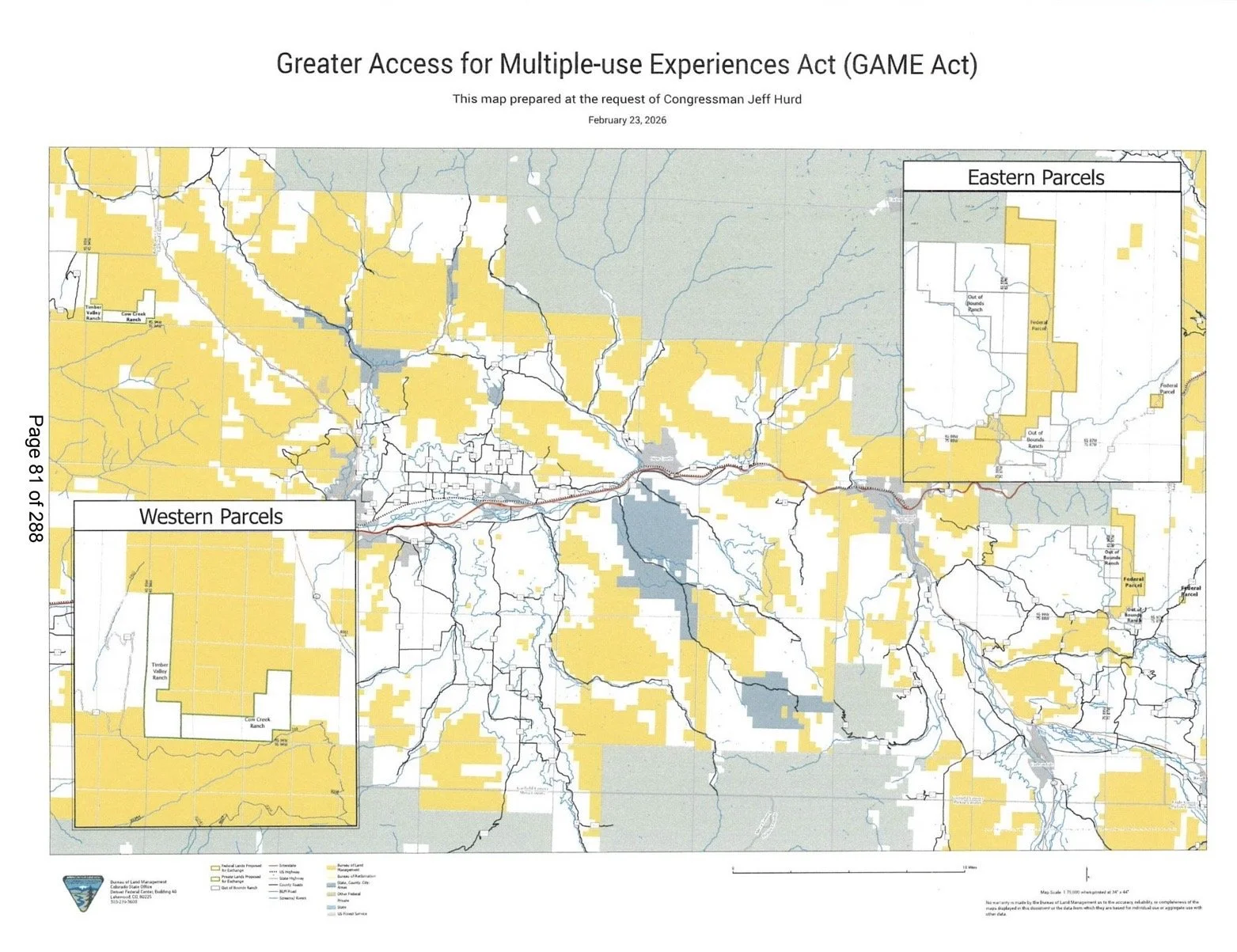
Cow Creek & Timber Valley are shown in red; existing BLM public lands are shown in yellow. The animation illustrates how the lands proposed to become public sit among and connect existing public holdings. Illustrative Google Earth imagery - not a legal survey.